
Understanding OSHA 1910.132(d): The Foundation of a Mercury-Safe Dental Practice
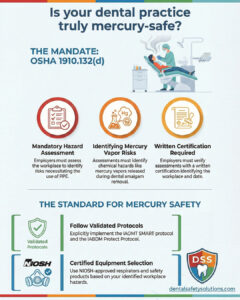
For dental professionals, protecting the team from occupational hazards—such as toxic mercury vapors, infectious aerosols, and chemical splashes—starts with a thorough understanding of OSHA 1910.132(d) [1]. This standard is the cornerstone of workplace safety, mandating that every employer perform a workplace hazard assessment to identify risks that necessitate the use of Personal Protective Equipment (PPE) [2]. In a specialized setting like a mercury-safe dental office, this assessment is the vital first step in successfully implementing clinical safety frameworks like the IAOMT SMART protocol or the IABDM Protect Protocol [3].
 Core Requirements of 1910.132(d)
If the assessment reveals that hazards are present or likely to be present, the employer has three mandatory obligations under 1910.132(d)(1) [4]:
- Select Appropriate PPE: Employers must choose specific gear that protects employees from the exact hazards identified, such as NIOSH-approved respirators for mercury vapor [5].
- Communicate Selection Decisions: Every affected employee must be informed of which PPE is required for their specific tasks [6].
- Ensure Proper Fit: PPE must be selected to properly fit each individual employee to ensure the equipment functions as designed [7].
Guidelines for the Assessment and Certification
OSHA provides Appendix B as a nonmandatory guide for conducting these surveys [8]. A professional assessment involves a physical walk-through to identify sources of chemical exposures, harmful dust, and light radiation [8]. Once completed, OSHA 1910.132(d)(2) requires the employer to verify the assessment through a written certification [9]. This document must identify the workplace evaluated, the person certifying the evaluation, the date, and be explicitly titled as a “certification of hazard assessment” [9].
The Vital Role of the Respiratory Program Administrator (RPA)
While a hazard assessment identifies the need for protection, OSHA 1910.134(c)(3) mandates that the employer designate a suitably trained Respiratory Program Administrator (RPA) to oversee the program [10]. The RPA is responsible for the establishment and maintenance of the entire respiratory protection program, ensuring it covers every employee required to use a respirator [11].
The importance of a qualified RPA cannot be overstated:
- Expert Oversight: The RPA must be qualified by training or experience to conduct required evaluations of program effectiveness [12].
- Compliance Maintenance: They are responsible for ensuring that medical evaluations are completed and annual fit testing is performed [13].
- Liability and Safety: Having a certified RPA empowers a practice to take full ownership of workplace safety, proactively slashing liability risks and building a reputation for accountability [14].
Get Certified and Simplify Compliance
Managing a compliant dental office is a complex task, but you don’t have to do it alone. At dentalsafetyssolutions.com, we offer comprehensive Respiratory Program Administrator Certification courses tailored specifically for the dental industry [15].
Whether you are an active RDH, DA, or a practice owner, this certification provides you with the expertise and 25 hours of continuing education (CE) credits (available to IABDM members) to lead your office in safety [16]. Our packages include everything from online medical evaluations to the tools necessary for qualitative Bitrex fit testing, ensuring your practice remains operational and fully compliant [15].
Visit dentalsafetyssolutions.com today to purchase your RPA training and secure the future of your practice.