
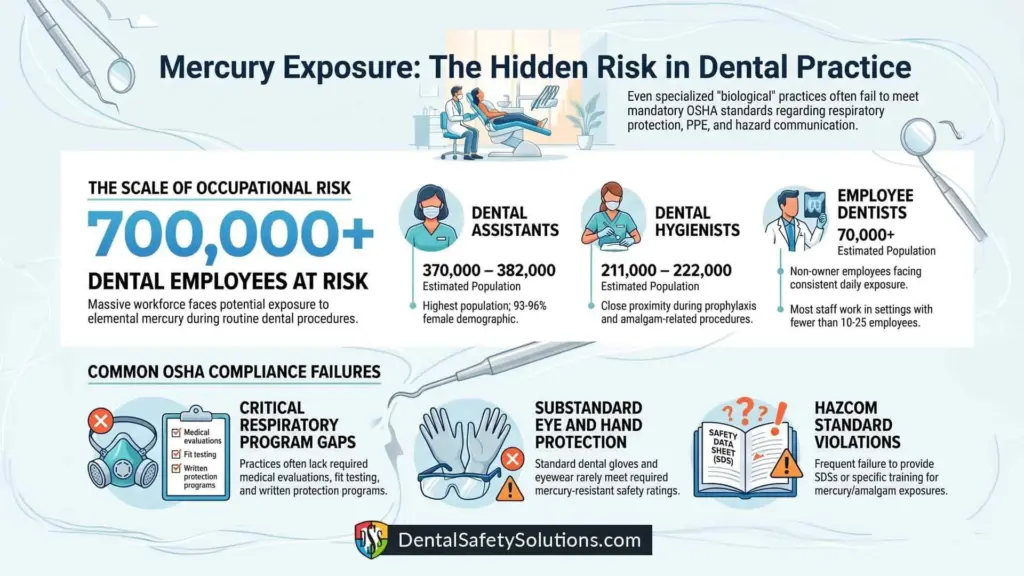
Dental assistants, hygienists, and other clinical staff share the same OSHA-covered workplace as the dentist who employs them. If a practice has one or more employees, the Occupational Safety and Health Act applies. OSHA has stated that dental employers must prevent hazardous mercury exposures, and that mercury is a hazardous chemical under Hazard Communication because it appears in OSHA’s air-contaminant tables (OSHA letter of interpretation, 2012).
What employees have a right to expect
Under federal rules, employees generally have the right to (OSHA Workers):
- A workplace free from recognized hazards that can cause serious harm
- Training on hazardous chemicals they may encounter—including mercury in amalgam—in a language they understand (Hazard Communication)
- Access to Safety Data Sheets (SDS), labels, and written hazard-communication materials
- Required protective equipment when a hazard assessment shows it is needed, at no cost
- Results of workplace hazard testing used to evaluate chemical exposures
- Speak up about unsafe conditions, report injuries or illnesses, and request an OSHA inspection without illegal retaliation
Mercury vapor and particulates are generated during placement, polishing, and especially removal of amalgam—so hazard communication, air-contaminant limits, PPE rules, and (when respirators are required) the Respiratory Protection Standard all matter in a dental operatory. For industry context, see OSHA’s Dentistry and Mercury topic pages and NIOSH’s mercury topic page.
OSHA does not have a mercury-specific substance standard that mandates medical surveillance for dental workers. Protection still comes from the general duty to control recognized hazards and from the standards that do apply (HazCom, air contaminants, PPE, and respiratory protection when respirators are required).
If you believe you have already been harmed
Act promptly and keep records:
- Seek medical care — Tell your clinician you work around dental amalgam/mercury and ask about appropriate evaluation. For urgent chemical-exposure questions, contact Poison Control at 1-800-222-1222 or poison.org. Background on health effects is also available from ATSDR’s mercury page.
- Ask your employer in writing for SDS sheets, training records, hazard-assessment documentation, and any workplace air-monitoring results related to mercury.
- File an OSHA safety and health complaint if you believe a serious hazard exists or standards are not being followed (online, phone, mail, or email). Signed complaints are more likely to trigger an onsite inspection: osha.gov/workers/file-complaint. OSHA generally cannot cite incidents older than six months.
- File a whistleblower complaint if you were fired, demoted, disciplined, or otherwise retaliated against for raising safety concerns. Under Section 11(c), the window is often 30 days from the retaliatory act — OSHA Whistleblower Protection Program.
- Consider a NIOSH Health Hazard Evaluation (HHE) when workplace exposures need independent evaluation — request an HHE and review NIOSH’s mercury resources.
- Contact your state workers’ compensation system (and, if needed, an employment or occupational-health attorney). Rules and deadlines vary by state. Start with your state labor department or workers’ compensation board; the U.S. Department of Labor maintains workers’ compensation overview resources.
Additional employee primers: OSHA’s Workers’ Rights booklet (PDF) and the Know Your Rights hub.
Dental Safety Solutions advocates for practical mercury controls and complete respiratory-program support so offices protect staff before harm occurs. Knowing your rights supports that culture—it does not replace engineering controls, training, and documented programs.
Educational advocacy only—not legal or medical advice. Confirm current procedures and deadlines with OSHA, your state plan, and qualified professionals.