
Many dental practices believe that once employees complete a respirator medical evaluation and annual fit test, they have met OSHA’s Respiratory Protection Standard. Others assume that sending an employee to a general respiratory protection course is enough to qualify them as the office’s Respiratory Program Administrator.
Unfortunately, neither assumption is correct.
OSHA’s Respiratory Protection Standard (29 CFR 1910.134) requires much more than medical evaluations, fit testing, or a general understanding of respirators. Employers must designate a qualified Respiratory Program Administrator who has the training, experience, and knowledge necessary to administer the entire respiratory protection program—and that includes understanding the specific respiratory hazards employees face in their own workplace.
For dental practices, those hazards are unique.
OSHA Requires More Than Medical Evaluations and Fit Testing
Medical evaluations and fit testing are only two components of OSHA’s Respiratory Protection Standard.
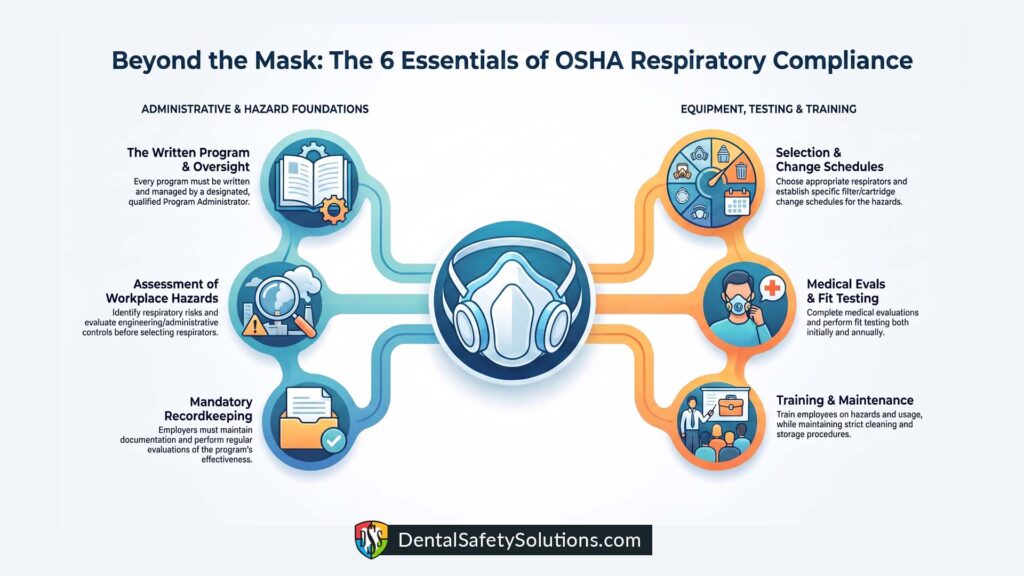
When respirators are required, employers must implement and maintain a complete Respiratory Protection Program that includes:
- A written Respiratory Protection Program
- Identification and assessment of respiratory hazards
- Evaluation of engineering and administrative controls before relying on respirators
- Selection of appropriate respirators for the hazards present
- Medical evaluations
- Initial and annual fit testing
- Employee training on respirator use and workplace hazards
- Cleaning, inspection, maintenance, and storage procedures
- Filter and cartridge selection
- Cartridge change schedules when applicable
- Program evaluation
- Recordkeeping
- Designation of a qualified Respiratory Program Administrator
Completing fit testing without implementing these additional program elements does not satisfy OSHA’s Respiratory Protection Standard.
What OSHA Says About the Respiratory Program Administrator
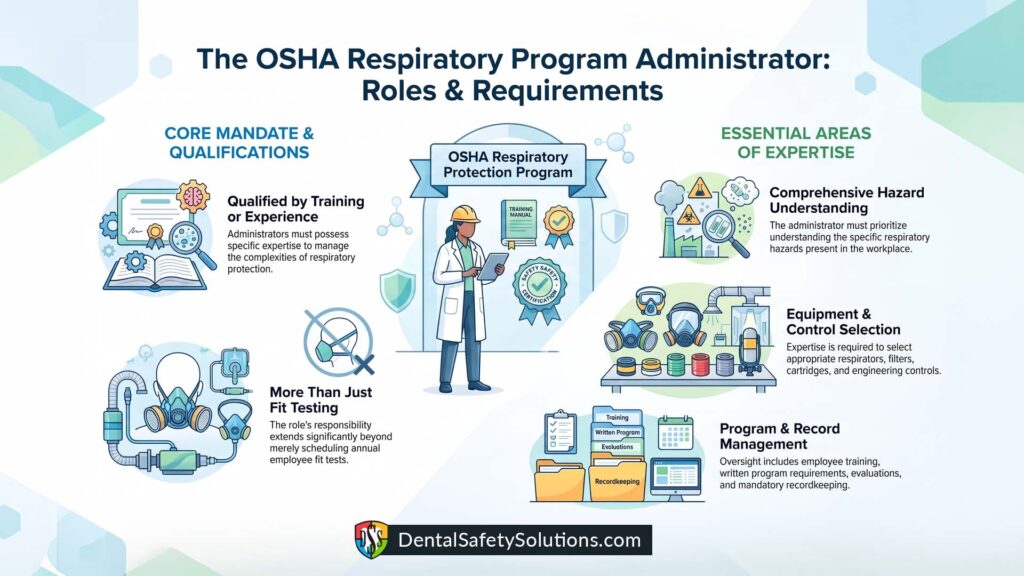
OSHA requires every employer with a required Respiratory Protection Program to designate a Program Administrator who is qualified by appropriate training or experience to administer the program.
This responsibility extends far beyond scheduling annual fit testing.
A qualified Respiratory Program Administrator must understand:
- The respiratory hazards present in the workplace
- How employees may be exposed
- Which engineering controls should be used
- When respirators are actually required
- Which respirators are appropriate
- Filter and cartridge selection
- Employee training requirements
- Written program requirements
- Program evaluations
- Documentation and recordkeeping
Most importantly, the Program Administrator must understand the hazards the respirators are intended to protect employees from.
Why Dental Offices Require Dental-Specific Knowledge
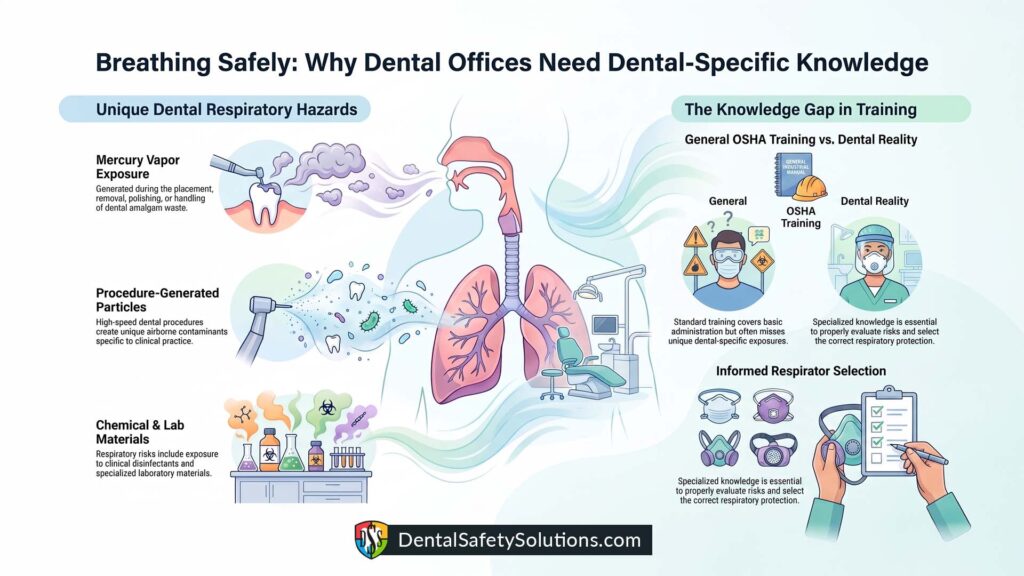
Respiratory hazards in a dental office are significantly different from those found in many other industries.
Dental personnel may encounter exposure to:
- Mercury vapor generated during amalgam placement, removal, polishing, waste handling, or accidental spills
- Mercury particles created during dental amalgam removal
- Other airborne contaminants specific to dental practice
Understanding these hazards is essential when determining whether respiratory protection is required, selecting appropriate respirators, and ensuring employees receive training that addresses the actual risks present in the workplace.
General respiratory protection training provides valuable instruction on OSHA requirements and respirator administration. However, unless the training specifically addresses dental respiratory hazards such as mercury, it will not prepare an administrator to properly evaluate the unique exposures encountered in dental practices.
General Respiratory Protection Training vs. Dental Respiratory Program Administrator Certification
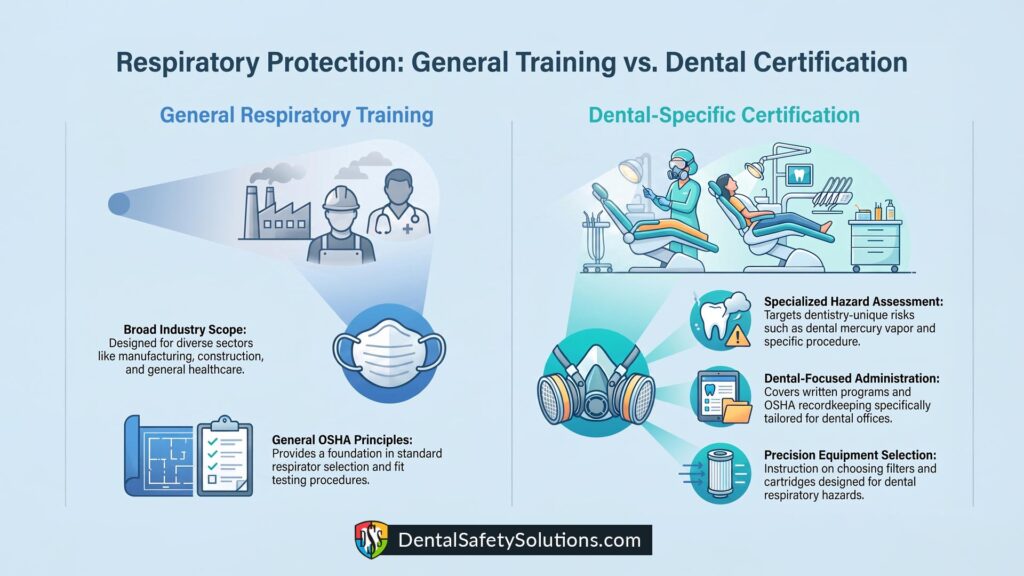
Many respiratory protection training providers offer excellent instruction on OSHA’s Respiratory Protection Standard, respirator selection, fit testing procedures, written programs, and general program administration across a wide variety of industries.
These courses are designed to provide a broad understanding of respiratory protection principles that can be applied in manufacturing, construction, healthcare, utilities, municipalities, and many other work environments.
Dental Safety Solutions’ Respiratory Program Administrator Certification takes a different approach.
Rather than teaching respiratory protection from a general industry perspective, the course focuses specifically on OSHA compliance in dental offices and the respiratory hazards unique to dentistry.
Participants receive training on topics including:
- OSHA respiratory protection requirements for dental practices
- Dental mercury vapor hazards
- Hazard assessments specific to dentistry
- Engineering and administrative controls used in dental settings
- Appropriate respirator selection for dental procedures
- Filter and cartridge selection for dental respiratory hazards
- Written Respiratory Protection Programs for dental offices
- Employee training requirements
- Required OSHA documentation and recordkeeping
- Program administration and annual evaluations
The objective is not simply to understand respirators—it is to prepare participants to competently administer an OSHA-compliant Respiratory Protection Program within a dental practice.
Why Hazard-Specific Training Matters
OSHA’s Respiratory Protection Standard is built on the principle that respirators are selected and used based on identified workplace hazards.
If a Program Administrator does not fully understand the hazards present in a dental office, important decisions may be made incorrectly, including:
- Whether respiratory protection is required
- Which respirator should be selected
- Which filters or cartridges are appropriate
- Whether engineering controls are sufficient
- What employee training is necessary
- How the written program should address the practice’s specific risks
This is why workplace-specific knowledge is such an important part of administering a compliant respiratory protection program.
OSHA Penalties Can Add Up Quickly—Even for Small Dental Practices
Each missing element of a Respiratory Protection Program may be cited as a separate OSHA violation.
Beginning in 2025, OSHA expanded its penalty reduction policy for small employers. Most dental practices with 25 or fewer employees may qualify for up to a 70% reduction in proposed penalties based on employer size. Additional reductions may be available for employers with a favorable inspection history and for promptly correcting hazards identified during an inspection.
Unfortunately, these penalty reductions have led some dental practices to believe they are somehow “exempt” from OSHA’s Respiratory Protection Standard. They are not.
The reductions apply only to the amount of the proposed penalty—they do not reduce an employer’s legal obligation to comply with OSHA regulations. Every requirement of OSHA’s Respiratory Protection Standard remains fully enforceable, regardless of the size of the practice.
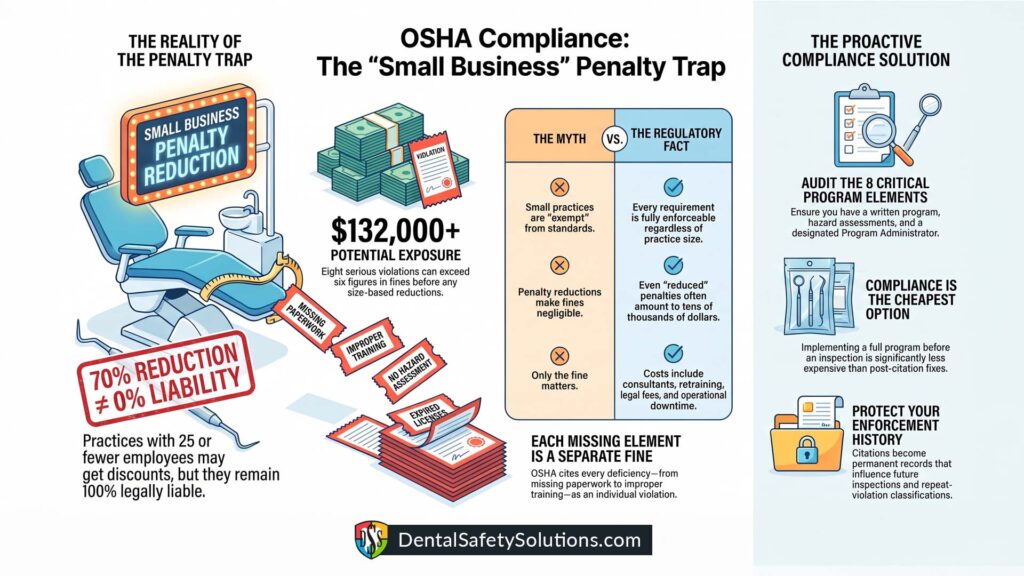
For example, if OSHA determines that a dental office is missing multiple required elements of its Respiratory Protection Program—such as:
- No written Respiratory Protection Program
- No documented respiratory hazard assessment
- Failure to designate a qualified Respiratory Program Administrator
- Inadequate employee training
- Improper respirator selection
- Missing filter or cartridge change schedules
- Failure to evaluate engineering and administrative controls
- Incomplete documentation and recordkeeping
each deficiency may be cited as a separate violation.
Without any penalty reductions, eight serious violations at the current federal maximum penalty could exceed $132,000 in proposed penalties. While most small dental practices would likely qualify for substantial reductions, even a significantly reduced penalty can still amount to tens of thousands of dollars, in addition to the cost of correcting every cited deficiency.
More importantly, the financial penalty is often only one part of the overall cost. Employers may also incur expenses for compliance consultants, staff retraining, policy revisions, administrative time, operational disruptions, and potential legal liability if an employee experiences an occupational exposure. OSHA citations also become part of the practice’s enforcement history and may influence future inspections or repeat-violation classifications.
The lesson is straightforward: penalty reductions should never be confused with reduced compliance responsibilities. OSHA’s small-business policies may lower the amount of a citation, but they do not lower the standards employers are required to meet. The most effective—and least expensive—approach is to implement a complete, OSHA-compliant Respiratory Protection Program before an inspection occurs, rather than relying on penalty reductions after violations have already been identified.
The Bottom Line
General respiratory protection training provides an excellent foundation for understanding OSHA’s Respiratory Protection Standard.
However, dental practices have respiratory hazards that are unique to the profession, including mercury vapor exposure and other airborne contaminants encountered during dental procedures.
A Respiratory Program Administrator responsible for protecting dental employees should understand not only OSHA’s regulations but also the specific hazards present in dental settings.
Dental Safety Solutions’ Respiratory Program Administrator Certification was developed specifically for dental professionals who must administer respiratory protection programs in compliance with OSHA while addressing the real-world respiratory hazards found in modern dental practices.
When employee safety, OSHA compliance, and regulatory responsibility are on the line, understanding dentistry is just as important as understanding respirators.