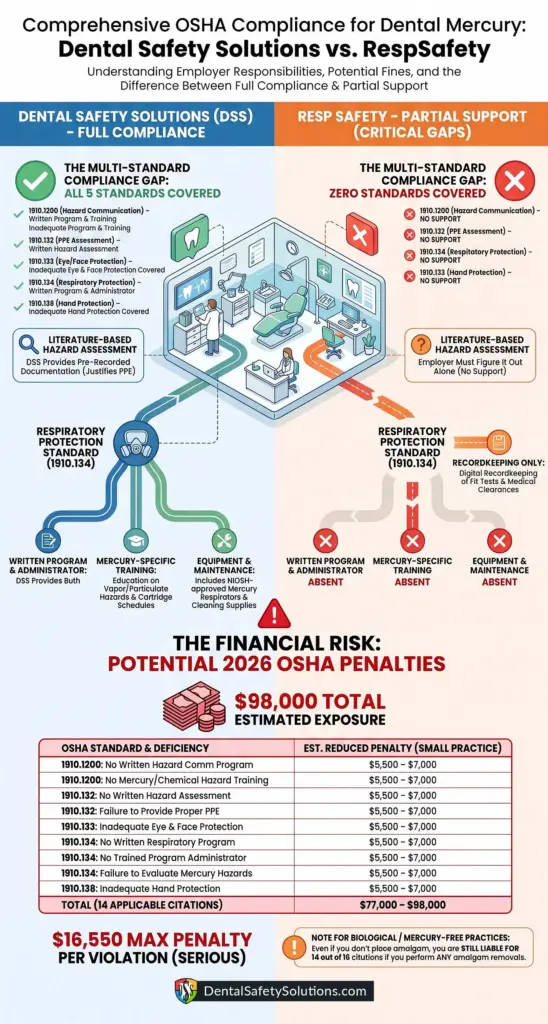
Understanding Employer Responsibilities, Potential Fines, and the Difference Between Full Compliance & Partial Support. Protecting dental employees from mercury exposure requires compliance with multiple interrelated OSHA standards, not just the Respiratory Protection Standard.
Mercury is a hazardous chemical (listed under air contaminants) that can generate vapors and particulates during amalgam placement, polishing, and especially removal. This triggers obligations across several rules for both employers (program development, hazard evaluation, training, documentation, provision of PPE at no cost) and employees (proper use and protection).
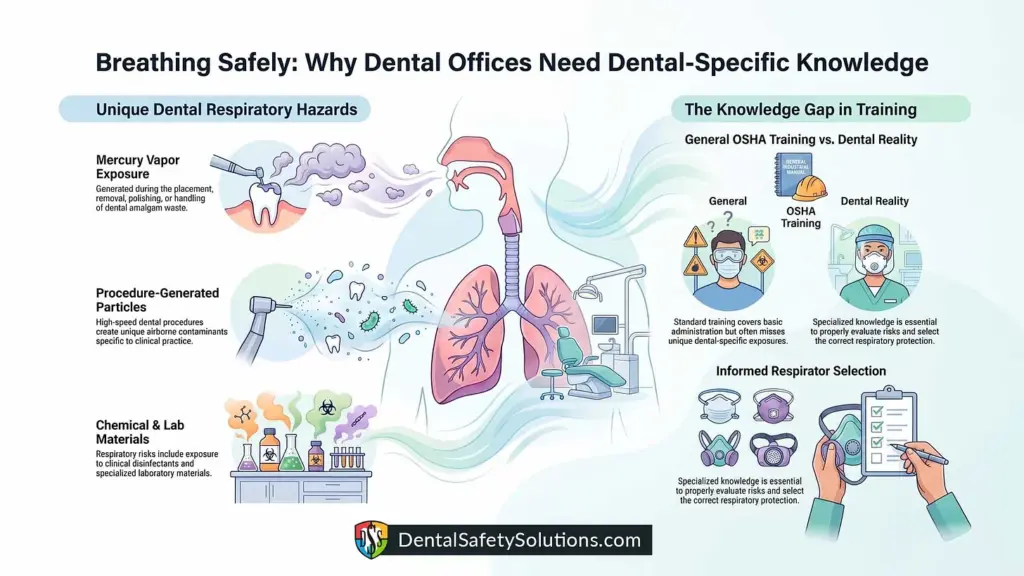
The relevant OSHA standards include:
1910.1200 – Hazard Communication: Requires a written program, chemical inventory, proper labeling, accessible Safety Data Sheets (SDS) for mercury/amalgam products, and employee training on chemical hazards, how to read SDS/labels, and protective measures.
1910.132 – PPE (General Requirements): Requires a workplace hazard assessment (with written certification identifying the workplace, evaluator, date, and document as a certification) to determine if hazards necessitate PPE, selection of appropriate PPE, communication of requirements, training on use/limitations/care, and provision at no cost.
1910.133 – Eye & Face Protection: Requires appropriate eye/face protection against chemical gases/vapors, flying particles, or other hazards identified in the assessment.
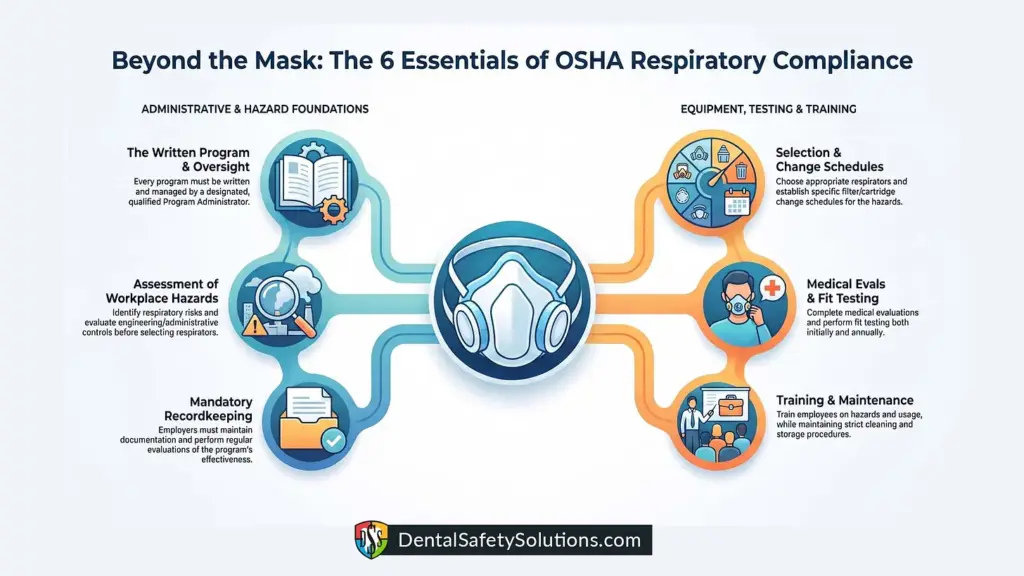
1910.134 – Respiratory Protection (core focus when respirators are needed): Written worksite-specific program administered by a suitably trained person; hazard evaluation for respirator selection; medical evaluations; fit testing; training (including on the specific respiratory hazards); maintenance/cleaning/storage; recordkeeping; and program evaluation. Hazard evaluation can rely on objective data, historical data, or published studies (on-site quantitative sampling is not always mandatory).
1910.138 – Hand Protection: Requires selection and use of appropriate gloves based on evaluation of hazards such as skin absorption of harmful substances (mercury can be absorbed dermally).
1910.1000 – Air Contaminants: Establishes permissible exposure limits (PELs) for mercury (and other substances). When exposures may exceed limits (as documented in published studies for certain dental procedures), employers must implement controls, including PPE/respiratory protection where needed.
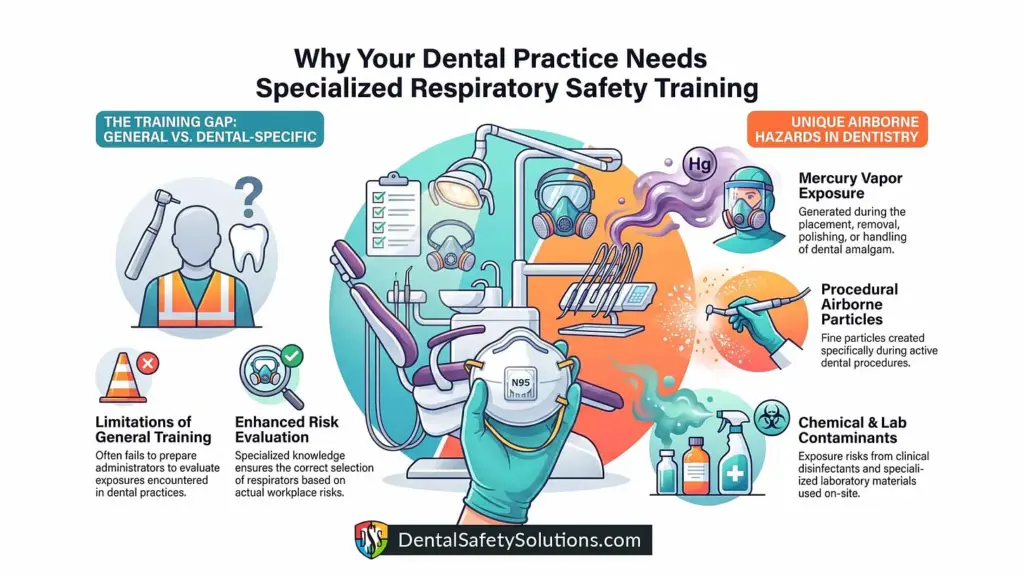 A literature-based written hazard assessment (drawing on extensive published studies showing mercury vapor/particulate levels can exceed limits during amalgam work) can support compliance across these standards by documenting the hazards, justifying PPE/respirator selection, informing training content, and feeding into written programs.
Site-specific quantitative industrial hygiene sampling by a CIH is one option but is not required if reliable objective/published data is thoroughly documented.
Comparison: Dental Safety Solutions (DSS) vs. RespSafety
Required Elements of OSHA 29 CFR 1910.134 (Respiratory Protection Standard)
Here is a table comparing the major required elements of OSHA Respiratory Protection Standard 1910.134, against what Dental Safety Solutions (DSS) and RespSafety provide.
- DSS packages are designed as a more complete solution for the full standard in a dental-mercury context (written program + administrator training + literature-based hazard assessment + equipment + hazard-specific training + medical evals + fit testing).
- RespSafety focuses narrowly on medical evaluations and fit-testing facilitation/recordkeeping. It does not address the written program, program administrator, hazard evaluation/selection, mercury-specific training, or maintenance elements.
- Employers remain responsible for adopting, customizing, and implementing the materials to their specific workplace.
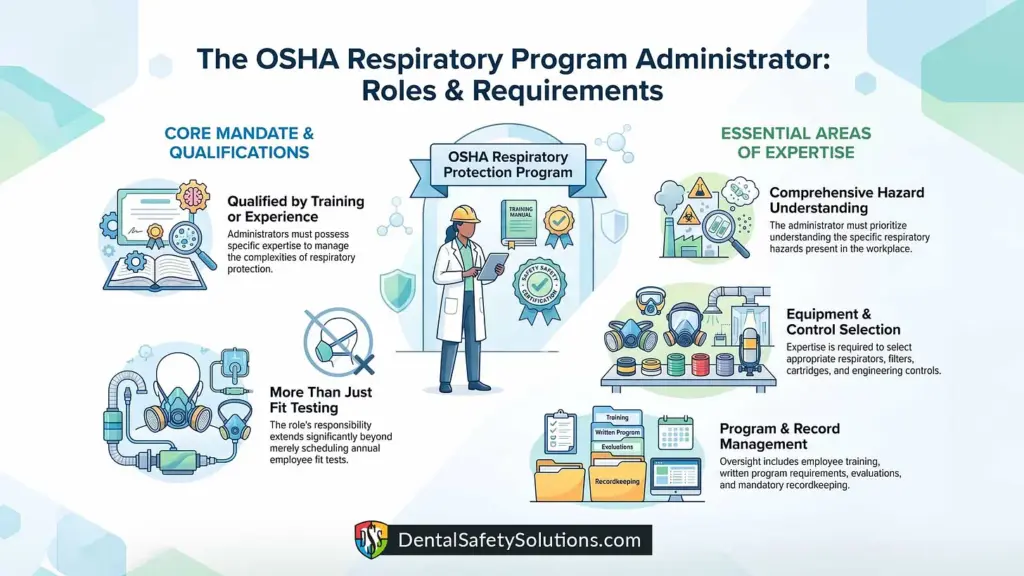
Dental Safety Solutions Respiratory Program Administrator for dental mercury certification is designed to help dental practices meet the multi-standard obligations for mercury protection by providing OSHA standards testing and training and a literature-based written hazard assessment that feeds into written programs, training on the specific chemical/respiratory hazards, appropriate equipment across PPE categories (including respirators tailored to mercury vapor + particulates), and education spanning Hazard Communication, general PPE assessment, eye/face/hand protection, air contaminant considerations, and the full Respiratory Protection Standard.
RespSafety addresses only three narrow pieces of 1910.134 (medical clearance, fit testing and record keeping for only those two aspects) and provides no support for the other standards, hazard characterization, or mercury-specific needs.
Employers remain responsible for site-specific adaptation, implementation, and ensuring full compliance (including any additional state requirements).
Other than DSS, a professional CIH quantitative assessment remains an option for practices wanting primary exposure data, but objective published data + a documented written assessment (as DSS facilitates) is a recognized path under the standards.
What are the potential repercussions of non-compliance?
Employer responsibility and potential fines: Dental employers remain fully responsible for adopting, customizing, and implementing a complete OSHA-compliant program for mercury protection in their specific workplace.
Relying solely on narrow services such as RespSafety (which covers only medical evaluations and fit-testing facilitation/recordkeeping) leaves critical gaps—including the absence of a written respiratory protection program, trained program administrator, hazard evaluation/selection, mercury-specific training, and maintenance elements—exposing the practice to multiple serious citations under 1910.134 and related standards (1910.1200, 1910.132, 1910.133, 1910.138).
Adjusted OSHA Penalty Exposure Table (2026 amounts)
Hypothetical for a dental employer who relies only on RespSafety’s limited offerings (medical evaluations + fit-testing support) and therefore lacks comprehensive employee protection from mercury and the required documentation/programs under the listed standards.
Important adjustment for biological / mercury-free practices: Many biological dentists do not place (or store) amalgam and therefore would not be cited for deficiencies that require the presence of mercury/amalgam product documentation. Those two items remain listed for completeness but have their penalty amounts struck out, as they would not apply in a practice that has eliminated amalgam.
2026 maximum serious penalty = $16,550 per violation.
Estimated reduced amounts assume a small dental practice after typical size, good-faith, and history adjustments (commonly $5,500–$7,000 per citation).
NOTES:
- The two red items within 1910.1200 Hazard Communication apply only if the practice still possesses, uses, or stores amalgam/mercury-containing materials. Biological dentists who have fully eliminated amalgam placement and storage avoid those specific citations.
- All other listed deficiencies (written programs, hazard assessments, training on residual or historical mercury exposure risks during removal of existing amalgams, PPE selection, respiratory program elements, etc.) can still apply whenever employees may be exposed to mercury vapor or particulates (e.g., during removal of old amalgam fillings).
- Medical evaluations and fit testing supported by RespSafety would generally avoid citation if properly documented.
- These are potential exposures only. Inspectors exercise discretion, items may be grouped, and final penalties are frequently reduced further in informal conferences or settlements.
- Willful/repeat classifications or failure-to-abate can significantly increase totals as they are calculated at $16,550 per day.
Choosing Dental Safety Solutions is essential for dental practices seeking true protection from mercury hazards and meaningful OSHA compliance, as its packages deliver a complete, dental-specific solution for mercury exposures, far beyond the narrow medical-evaluation and fit-testing focus of services like RespSafety.
By addressing the full spectrum of employer obligations under 1910.134 and companion rules, DSS helps practices avoid the substantial financial exposure of multiple serious citations, while equipping both employers and employees with the documentation, equipment, and knowledge needed to manage real-world amalgam-related exposures, including during removal of existing fillings.
Ultimately, selecting a specialized provider like DSS enables practices to meet their non-delegable legal responsibilities more effectively, safeguard staff health, and minimize regulatory risk in a way that incomplete, generalist tools simply cannot.